

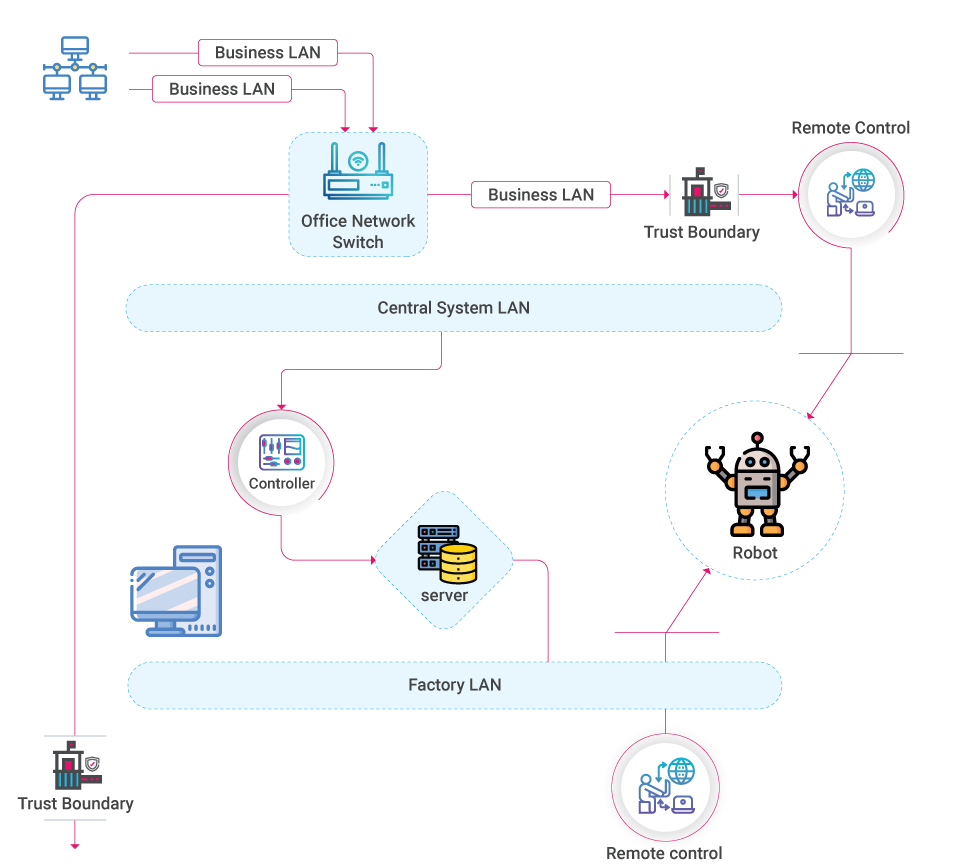
Robotics Ecosystems: The technological revolution experienced in the past two decades has seen an expansion in use of robots to perform critical tasks that require human intelligence. In the near future, robots will be everywhere used in mainstream operations such as military missions, business assistants, building and construction, healthcare attendants, and assisting with home management. As such, robots will access critical information, which if compromised could adversely affect the owners. The functionalities of robots range from local operation to remote control, spanning over trust boundaries, thus exposing the robotics ecosystem to cyber threats. It is, therefore, important to ensure that these smart machines are well protected, secure, and not easy to hack. Otherwise, they can be compromised by malicious attackers posing a serious threat to the organizations, people, and organizations in which the robots operate.
How do Hackers get into Robot Ecosystems?
Attackers who target robot ecosystems can compromise the physical robot, robot operating system, firmware, software, remote control applications, and robot networks, among other components in the ecosystem. For instance, hackers can utilize insecure communication, authentication issues, weak cryptography, weak default configuration, and vulnerable open source robot frameworks and libraries to get into the robotic systems. Below is a brief discussion of how hackers could utilize the listed weaknesses to get into the robotics ecosystems.
Insecure Communication
Communication channels allow users to interact with the robotics ecosystem’s components and facilitate the functionality of the robot. For instance, a user can send real time commands to a physical robot from a mobile application through a robot communication channel. If not well protected, attackers can intercept such communication and steal confidential information or compromise the robot. As such, it is important to use thus protecting the robot ecosystem from compromise.
Authentication Issues
Most robotic services can be accessed remotely using a mobile application, computer software, or internet services. Following the access, users execute critical robot functions such as issuing commands and programming the robots remotely. As such, it is important to identify users authorized to access functions of robot and what they are allowed to do. Failure to properly authenticate users open a loophole for attackers to remotely use features in the robot ecosystem without valid username and password. Such attackers can issue commands to remotely execute their malicious intent.
Vulnerable Open Source Robot Frameworks and Libraries
Many robots use open source frameworks and libraries that are shared among multiple vendors for robot programming and development in the robotics community. These shared libraries and frameworks suffer common cyber-security vulnerabilities such as clear-text communication and authentication issues. Additionally, most robotic vendors develop robotic research projects into commercial products without implementing additional cyber security protections. As such, the robots are not adequately protected since research projects have inadequate cyber-security protections, and in other cases none. Hackers can, therefore, utilize these known weaknesses to break into the robotic systems without much struggle.
Protect Robotic Ecosystems from Hackers
Research shows that players in robotics industry prioritize time to market over security consideration leaving loopholes that can be easily utilized by attackers. As such, there is a need for change in tune to ensure that security considerations are addressed as advocated for by prominent scientists including Stephen Hawking and Elon Musk.
The best way to address these concerns is to implement cybersecurity protection right at the storage level. Flexxon introduces X-PHY, the first standalone embedded AI Cyber-security SSD that offers advanced security right at the storage level. X-PHY Cyber Secure SSD trusts no one and will always be the last line of defense to protect robotics ecosystem from cyber-attacks where other forms of defense have failed.