


It is not every time that security breaches come from anonymous hackers in some distant location. Sometimes, these attacks originate from within the organization itself. These are known as insider threats. These are security risks that come from people who have authorized access to company systems and data. Unlike external attackers who must first breach security perimeters, insiders start with trust, authorization, and knowledge of internal systems. They are particularly challenging because they involve people who already have legitimate access to the organization’s resources.
Insider threats are security risks originating from individuals with authorised access—such as employees, contractors, or third-party partners—who misuse or unintentionally compromise an organisation’s systems or data. These threats may be negligent, malicious, compromised, or collusive, and can lead to data theft, sabotage, or prolonged undetected breaches due to their privileged access. Effective mitigation requires least-privilege access controls, continuous monitoring, and a structured insider threat programme.
What Are Insider Threats?
An insider threat occurs when someone with authorized access to an organization’s assets misuses that access to negatively affect the organization’s critical information or systems. The Cybersecurity and Infrastructure Security Agency (CISA) defines insider threat as “the threat that an insider will use their authorized access, intentionally or unintentionally, to do harm to the department’s mission, resources, personnel, facilities, information, equipment, networks, or systems.” What makes insider threats particularly concerning is their privileged position. These advantages mean they can often cause significant damage while avoiding detection for extended periods.
They already possess:
- Knowledge of valuable assets and where they’re stored
- Understanding of security measures and policies
- Legitimate credentials to access protected systems
- Familiarity with operational patterns and vulnerabilities
Who Qualifies as an Insider?
An insider is any person who has or had authorized access to or knowledge of an organization’s resources. This includes:
- Employees across all levels of the organization
- Contractors and temporary workers
- Vendors and service providers
- Business partners with system access
- Former employees whose access credentials remain active
- Consultants and advisors
- Custodial or maintenance personnel with physical access
- Anyone supplied with computer or network access
It’s important to note that insiders aren’t limited to current employees. Anyone who has been granted legitimate access to facilities, systems, or information at any point could pose an insider threat if that access is misused.
Types of Insider Threats
Unintentional or Negligent Insiders
These individuals cause harm without malicious intent. They might:
- Misplace sensitive documents or devices
- Fall victim to phishing or social engineering attacks
- Accidentally send sensitive information to the wrong recipient
- Bypass security protocols for convenience
- Ignore security updates and patches
- Allow unauthorized access to restricted areas
- Improperly dispose of confidential information
According to research by the IBM, negligent insiders account for approximately 55% of all insider incidents. Though unintentional, these actions can still result in serious data breaches or system compromises.
Malicious Insiders
Unlike negligent insiders, malicious insiders deliberately seek to harm the organization. Their motivations may include:
- Financial gain through theft or sale of data
- Revenge for perceived workplace injustices
- Ideological differences with the organization
- Coercion by external parties
- Career advancement through sabotage of colleagues
- Competitive advantage when moving to a new employer
Malicious insiders might engage in data theft, sabotage of systems, unauthorized disclosure of confidential information, or even workplace violence. While less common than negligent threats, malicious insiders often cause more severe damage because their actions are calculated and targeted.
Compromised Insiders
A compromised insider is someone whose credentials or system access has been hijacked by an external threat actor. Though the insider themselves may not be aware of the compromise, their accounts are gateways for attackers to access internal systems with legitimate credentials. This scenario combines the stealth of an external attack with the privileged position of an insider. This can happen through:
- Stolen login credentials via phishing
- Malware that captures authentication details
- Social engineering tactics that trick users into granting access
- Blackmail or coercion
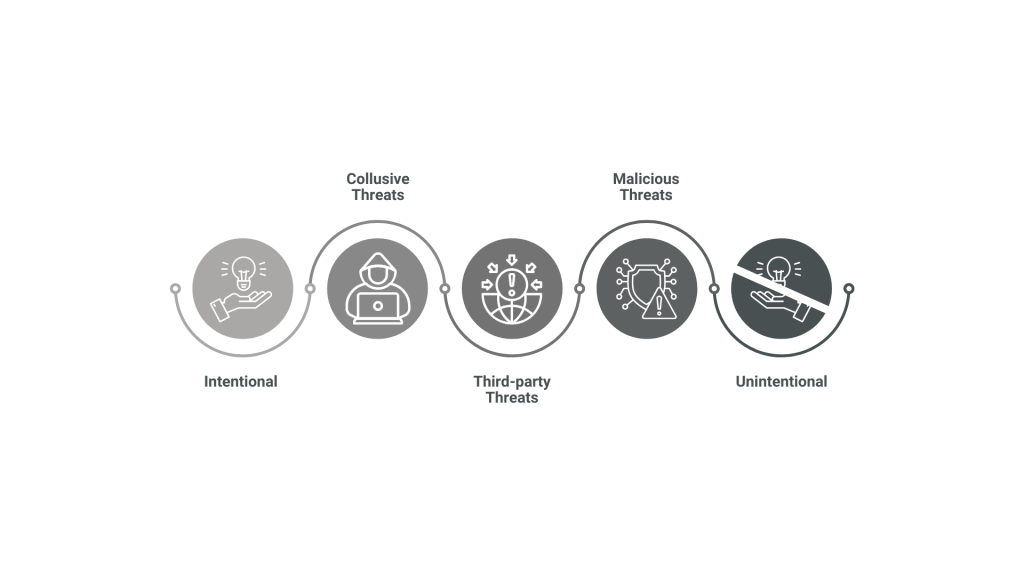
Collusive Threats
Some insider threats involve collaboration between an internal employee and external threat actors. The insider might deliberately provide access or information to outside criminals or competitors in exchange for payment or other benefits. These arrangements are particularly dangerous as they combine internal knowledge with external resources and techniques.
Third-Party Threats
Organizations often grant access to vendors, contractors, and other third parties who need to interact with internal systems. These individuals, while not direct employees, still qualify as insiders when they have authorized access. The risk increases when third parties have access to multiple client organizations.
How Insider Threats Manifest
Information Theft
One of the most common expressions of insider threats is the theft of sensitive information:
- Customer or client data
- Intellectual property
- Trade secrets
- Financial information
- Strategic plans
- Employee personal information
This information may be stolen for personal use, to sell to competitors, or to share with external threat actors. In some cases, employees take proprietary information when leaving for a new job, believing they have some ownership of work they helped create.
Sabotage
Insiders may deliberately damage physical or virtual infrastructure to disrupt operations. This includes:
Physical Sabotage:
- Damaging equipment or facilities
- Tampering with manufacturing processes
- Disrupting utility services
- Contaminating clean rooms or sterile environments
Virtual Sabotage:
- Deleting critical data
- Corrupting backups
- Introducing malware or backdoors
- Modifying code to create vulnerabilities
- Deliberately misonfiguring systems
Espionage
Some insider threats involve espionage activities where information is secretly gathered and transmitted to external parties. This can include stealing trade secrets for competitor advantage, gathering financial or strategic information or collecting manufacturing methods or formula. These activities can continue for extended periods before detection, especially when perpetrated by trusted employees with financial authority.
Disgruntlement and Revenge
Employees who feel mistreated, undervalued, or unfairly disciplined may seek revenge against the organization. Triggers might include:
- Being passed over for promotion
- Receiving a negative performance review
- Conflicts with management or colleagues
- Feeling unrecognized for contributions
- Pending termination or layoff
These feelings can intensify when combined with personal stressors outside the workplace.
Examples of Insider Threats
Tesla Data Theft (2018)
A former process technician at Tesla was found to have exported gigabytes of proprietary data to third parties. The employee allegedly made changes to Tesla’s Manufacturing Operating System under false usernames and exported large amounts of data to unknown recipients.
Capital One Data Breach (2019)
A former Amazon Web Services employee exploited a misconfigured web application firewall to access Capital One’s stored data in the cloud. The breach affected approximately 100 million Americans and 6 million Canadians, exposing Social Security numbers, bank account numbers, and personal information.
Cisco Insider Attack (2018)
A disgruntled former Cisco employee accessed company cloud infrastructure after resignation and deleted 456 virtual machines used for Cisco’s WebEx Teams application. This resulted in thousands of users losing access to their accounts for two weeks. The incident cost Cisco approximately $1.4 million in employee time for remediation and over $1 million in customer refunds.
Marriott International Data Breach (2018)
Attackers maintained access to Marriott’s Starwood guest reservation database for approximately four years before detection. While the initial breach may have been external, the extended access resembled insider activity, as the attackers operated with internal credentials and access rights. The breach exposed personal information of approximately 500 million guests.
The Cost of Insider Threats
Financial Impact
According to IBM’s Cost of a Data Breach Report, insider threats are among the most expensive security incidents to remediate, with data breaches initiated by malicious insiders costing organizations $4.88 million on average. Smaller incidents can still cost hundreds of thousands of dollars, making insider threats a significant financial risk even for mid-sized organizations. These costs include:
- Investigation and forensics
- Regulatory fines and penalties
- Legal costs and settlements
- Customer notification and credit monitoring
- Lost business and reputation damage
- Remediation and system repairs
Operational Disruption
Beyond direct financial costs, insider attacks often cause operational disruption. These disruptions can sometimes exceed the direct financial impact, particularly for organizations where timing and availability are critical:
- System downtime
- Loss of productivity
- Diversion of IT resources to incident response
- Business continuity challenges
- Delays in projects or service delivery
Reputational Damage
Perhaps the most difficult cost to quantify is damage to reputation. When customers, partners, or investors learn an organization has suffered an insider attack, it can erode trust and confidence. The Ponemon Institute reports that organizations take an average of 85 days to detect and contain insider threats. This extended exposure period increases both the amount of damage possible and the complexity of remediation. Some insider threats have gone undetected for years, allowing extensive access to sensitive systems and data. This damage often lasts long after systems are restored and can affect:
- Customer retention
- Partnership opportunities
- Investor confidence
- Ability to recruit talent
- Market valuation
- Detection Time
Preventing and Mitigating Insider Threats
Establish an Insider Threat Program
A formal insider threat program provides structure and governance for prevention efforts. Key components include:
- Executive sponsorship and support
- Clear policies and procedures
- Defined roles and responsibilities
- Risk assessment frameworks
- Incident response plans
- Regular program evaluation and improvement
Implement the Principle of Least Privilege
Restrict access rights to the minimum necessary for employees to perform their jobs. These restrictions limit what any single insider can access, reducing the potential impact of both malicious and accidental incidents. This means:
- Granting only necessary system permissions
- Limiting access to sensitive data
- Implementing time-based access controls
- Regular reviews of access rights
- Prompt removal of access when no longer needed
Conduct Background Checks
Thorough background screening helps identify risk factors before providing access to sensitive systems. Background checks should occur both during hiring and periodically for employees in sensitive positions.
This should include:
- Criminal history verification
- Employment history confirmation
- Education verification
- Reference checks
- Credit checks for finance positions
- Social media review
Conclusion
As security perimeters become less defined due to cloud computing and remote work, the distinction between insider and outsider threats continues to blur. This makes insider threat programs even more vital for protecting critical assets and maintaining operational integrity.
The most effective approach combines vigilance with trust – implementing necessary controls while maintaining a positive work environment that reduces the motivation for malicious actions.